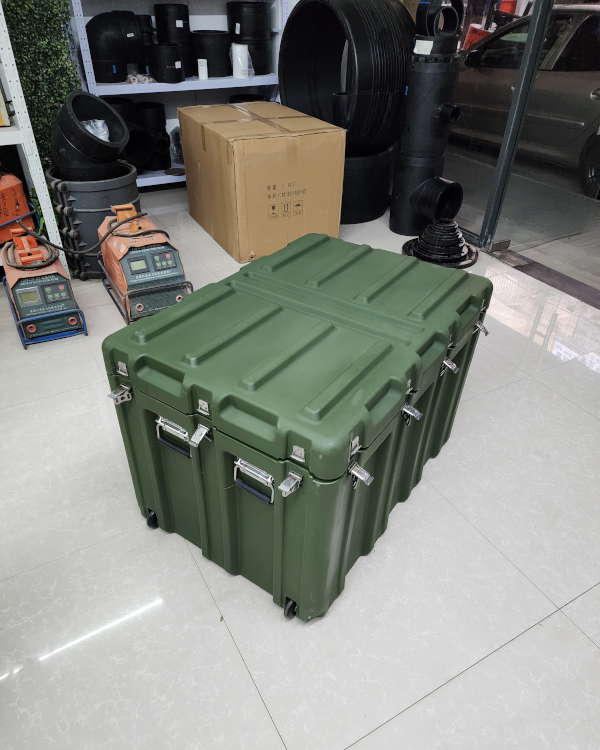
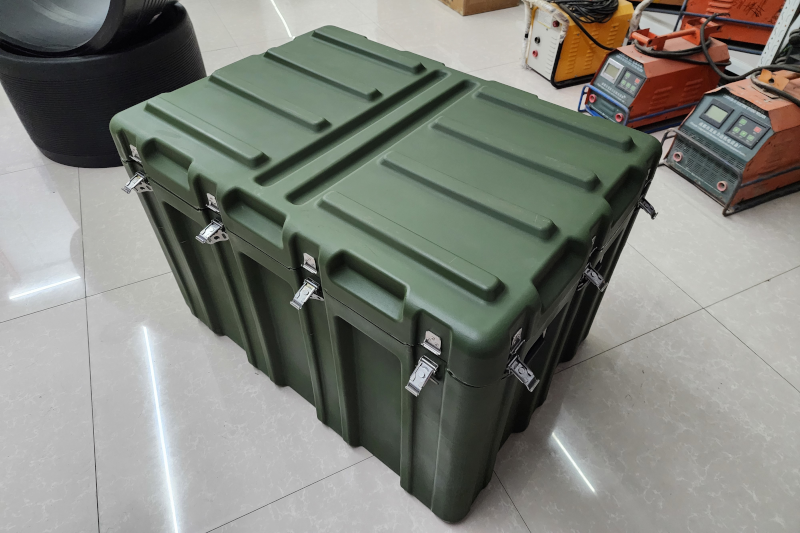
This page is the working brief for one kind of enclosure: a large-format transit case that has to move equipment, carry medical supplies, or sit outside a fire or border post until it is needed. It sets out what the case has to prove in each of those roles, how the composite shell and the seal are specified against it, what the interior load plan looks like, and how a finished case is accepted. None of it is a catalogue: every number below is fixed per project, in writing, before the first panel is cut.
What changes between these roles is not the size of the shell. It is what the case has to prove, and therefore which decision has to be made first.
01
Equipment transfer
Repeated short moves · mixed loads
Instruments, tools and spares moving between buildings, vans and sites. The case is opened and re-packed by different people under time pressure, so the load plan has to work without the person who designed it. It must prove stacking strength on a van deck, latch life over hundreds of cycles, and an interior that still locates its contents after somebody has packed it in a hurry.
Fixes the buildHow many different items share one case, and how much that list is expected to change.
02
Medical supply loading
Clean interior · moisture control
Consumables, instruments or field medical stock that has to arrive sealed and clean. Nothing inside may shed fibres, hold moisture, or leave a seam that cannot be wiped. It must prove gasket integrity every time the lid is closed on a busy shift, humidity control during sealed storage, and an interior with no crevice a disinfectant cannot reach.
Fixes the buildThe cleaning regime, and whether contents are expiry-controlled and counted at every opening.
03
Fire & border post storage
Outdoor dwell · gloved operation
Protective equipment, tools and spares held at a post until an incident. The case sits in sun, frost and dust for months, then has to open and close in the dark, in gloves, under load. It must prove UV and thermal cycling without the gasket taking a set, dust ingress at the rated level, and hardware — latches, handles, vent — that works with a gloved hand.
Fixes the buildDwell time and the temperature range at the post, not the weight of the contents.
A transit case is three things at once: a load path, a pressure boundary, and an inventory. Design it as one of them and the other two fail in service.
First rule of enclosure specification
02 · Enclosure
The shell takes the load, the seal holds the boundary
The body is a composite: closed-moulded glass-fibre skins over a structural core, or a ribbed polymer shell where weight and unit cost matter more than stiffness. Two numbers choose between them — the stacking load the case has to survive and the packed weight one or two people have to lift — and then the quantity: a single case can be built around a moulded shell, while a fleet rarely justifies one mould for a short run.
Reinforcement is local, not uniform. The rim, the four corners, the latch strike plates, the castor mounts and the top surface that carries the stack are where force enters and leaves the case. A uniformly thick wall spends weight everywhere else and still flexes at the corners.
01
Outer skin
UV-stable, impact-resistant face — the surface that meets a tail-lift edge and a concrete floor.
02
Local reinforcement
Ribs and plates behind handles, latches, castors and the stacking surface, so hardware lands on structure.
03
Core
Stiffness without mass. Thickness follows the stacking load, not the drop test.
04
Inner liner
Wipeable and non-shedding where medical stock shares the case; smooth and bondable where a foam cradle is fixed.
05
Gasket channel
Machined into the rim rather than bonded onto it, so the seal sits in a groove that cannot wander.
Envelope is measured to the outermost point — latches, castors, lid crown — with the load packed. Not to scale.
Where the load path is decidedHandles, latches, castors and stacking feet are not accessories added after the shell. Each one has to land on a reinforced point, and that point has to exist in the wall before the tooling is fixed. Hardware moved late is the most expensive change in the project.
03 · Sealing
Water, dust, and the pressure nobody plans for
A sealed case is a pressure boundary with hardware on it. Four things decide whether it stays one.
The seal is a compression design
A hollow or solid EPDM or silicone profile sitting in a machined channel, closed by latches that pull a fixed compression around the whole perimeter. A thicker gasket does not seal better; it only loads the latches and lifts the lid off the rim.
A rating is conditional
Dust-tight (IP6X) and water protection to IPX5–IPX7 are tested to IEC 60529 on an assembled, latched case with the vent closed. The rating describes the closing procedure as much as the gasket: a case closed with a strap caught in the rim has no rating at all.
Pressure has to go somewhere
Altitude, sun and temperature swings push air through the gasket in both directions. An equalisation vent lets the case breathe without letting water in, keeps the lid from fighting the latches, and stops the gasket taking a permanent set after a few flights.
Moisture inside is a separate problem
A sealed case traps the air it was closed with. For medical and instrument loads, a desiccant pocket and a humidity indicator window make that air visible at every opening instead of a surprise at the point of use.
Seal failures are usually not the gasketThe usual causes, in order: contents packed above the rim so the lid loads the seal unevenly; latches tightened to compensate for an over-filled case; a channel left with grit in it; and a gasket replaced with a thicker profile that changes the compression the latches were set for.
04 · Interior
Three load plans, and what each one costs you
The interior decides whether the case is re-packed correctly by someone who has never seen it. Choose by how much the contents change, not by how the case looks when it is opened for a photograph.
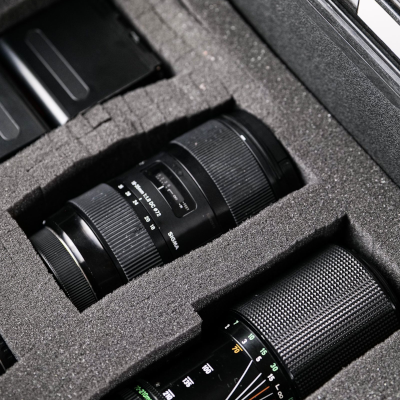
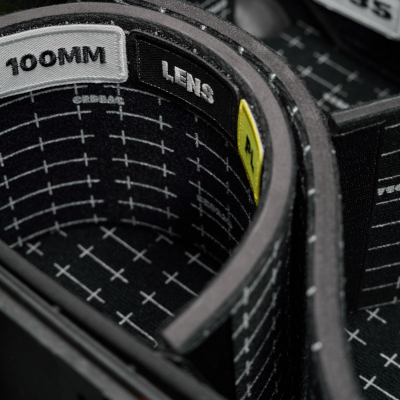
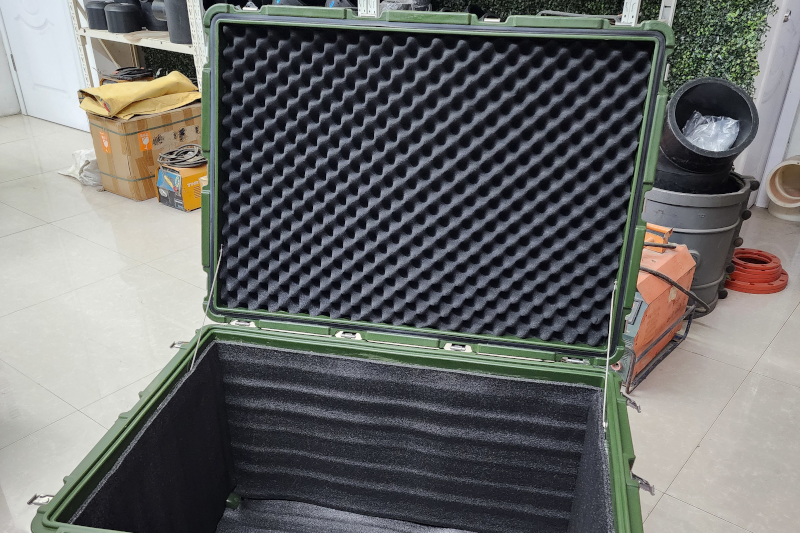
Milled foam cradle
Cut to the load · positive location
Strength: recesses cut to the outline of every item, with a stiff base layer and a softer contact face. Each item has one place, a missing item is visible at a glance, and nothing shifts under vibration.
Limits: one change to the load means a new block, and the complete load list has to be final before cutting starts.
Best for: a fixed equipment set that is moved repeatedly, where the same person is not always packing it.
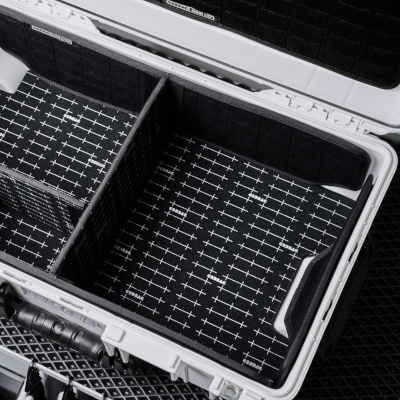
Adjustable divider field
Reconfigurable cells · mixed loads
Strength: padded dividers on a hook-and-loop field re-plan in minutes and lift out for cleaning — the cheapest way to carry medical stock and spares that change weekly.
Limits: weak lateral restraint. Heavy items push dividers aside under vibration, and sharp edges need wrapping.
Best for: consumables, spares and loose kit in mixed sizes, where counts change more than shapes do.
Tray & rail stack
Layered access · partial loads
Strength: trays on rails let a crew take one layer to the point of use without unpacking the case, and use the interior vertically instead of as one deep cavity.
Limits: less support for tall or fragile items, and the stack has to be retained — a free tray becomes loose mass inside the case.
Best for: small parts, instruments and consumables in quantity, at sites where the full kit is never needed at once.
The combination we specify most oftenA milled cradle for the fixed equipment set, a divider field for consumables and spares in the remaining volume, and one tray level in the lid for whatever is used first. Three zones each doing one job survive a load change better than a single system applied to the whole case.
05 · Process
Six steps from route to a released case
Each step needs one decision from your side. A missing decision does not stop the project; it moves the change later, where it costs more.
01
Route and duty brief
Name the worst route the case will travel, the dwell it has to survive, and how it is handled: by hand, tail-lift, van, air or sea. This is the statement the enclosure is designed against, not a summary written afterwards.
Output: one written duty statement, agreed.
02
Envelope and load list
Measured envelope for every item in its packed state — handles, cables and valve stems included — plus the accessory list and the count of each. Measure the outermost point, never the body shell.
Output: dimension sheet and counted load list.
03
Interior load map
A 1:1 layout: a pocket or cell for every item, finger reliefs, layer heights, which items share a zone, and where desiccant, documents and the humidity indicator sit.
Output: signed layout drawing — the machining reference from here on.
04
Shell, wall and hardware spec
Shell size from the envelope plus liner allowance, wall build-up from the stacking load, hardware from the handling method. Seal profile, vent, latching, mobility and marking are all fixed here — this is the last cheap point to change any of them.
Output: the specification sheet for signature.
05
Prototype and verification
One case is built and put through the checks in §06 with the intended load inside it. Seal seating, latch effort and interior fit are corrected on the prototype, not on the batch.
Output: test record and marked-up prototype.
06
Production and acceptance
Batch build to the released specification, then acceptance unit by unit: latch operation, seal seating under a closed lid, interior fit, marking, and the documents that travel with the case.
Output: released cases, spare liner set, archived specification.
The most common rework triggerQuoting from the body footprint and leaving out castors, lid crown and the load protruding above the liner. That is why a case arrives too shallow, and why the lid then loads the seal every time it is closed.
06 · Verification
How a case is released
No case is released on a rating alone. Each check is run on the assembled case with its intended load, and the pass criteria are written into the specification sheet at sign-off.
CheckMethodReleased when
Ingress
MethodSpray and dust exposure to IEC 60529, on the latched case with the vent closed.
Released whenNo water inside, no dust on the load face, channel clean.
Closed-lid drop
MethodCorner, then face, at the packed weight, onto a hard floor.
Released whenLid stays latched, no load shift, interior intact.
Stacking
MethodLoaded cases stacked to the specified height for a set time at the route temperature.
Released whenDeflection within the agreed limit and the lid still operates.
Transit vibration
MethodDistribution-cycle profile to ISO 4180 / ASTM D4169 for the intended route.
Released whenNo abrasion through the liner; fasteners still at torque.
Thermal cycling
MethodRepeated cycles across the post's range with the case sealed.
Released whenThe gasket returns to profile; no condensation on the load.
Latch cycle
MethodOpen and close to the specified count — gloves on for field roles.
Released whenCompression still in range, latch effort within the agreed limit.
Cleaning
MethodWipe-down with the site's own disinfectant, then interior inspection.
Released whenNo lifted liner edge, no fibre shedding, no trapped residue.
Field trial
MethodOne case on the real route for the agreed period, packed by the crew who will use it.
Released whenThe crew reports no damage and no load shift.
Standards are named so the conversation starts from a method rather than an adjective. Which of these apply, and the numeric pass limits, are set per project on the duty brief.
07 · Configurable items
Decisions, item by item
The configurable items, the common options, and the question each one has to answer at sign-off. Final values come from measurement and confirmation, never from a default.
Envelope
OptionsInternal width, depth and height from the measured load; external size set by the transport mode — van deck, tail-lift, pallet footprint, air-cargo contour.
ConfirmThe outer size is decided by how the case is moved, not only by what goes inside it.
Shell material
OptionsClosed-moulded glass-fibre skins over a core; ribbed PP copolymer; aluminium frame with composite panels.
ConfirmStacking load and packed weight pull in opposite directions — say which one is allowed to lose.
Wall build-up
OptionsSkin thickness, core type and thickness, local reinforcement at hardware and stack points.
ConfirmHow high the cases are stacked, and for how long at a time.
Seal
OptionsHollow or solid EPDM / silicone gasket in a machined channel; single or double perimeter; replaceable in the field.
ConfirmWhether the case is opened daily (compression set) or dwell-stored for a season.
Ingress target
OptionsDust-tight to IP6X; water to IPX5 for spray, IPX7 for temporary immersion.
ConfirmRain, wash-down and flooding are three different tests — pick the one the route actually presents.